Designing for trustworthiness, not trust
Financial services has a trust problem, and it is not a communications problem. In the UK, the Financial Conduct Authority's Consumer Duty has changed the regulator's question from "did you follow the rules?" to "did the customer end up better off?". Trustworthiness is now a compliance requirement. Most firms still answer with brand campaigns that say "trust us", and customers, quite reasonably, don't believe them.
The deeper issue is that trust gets treated as something a business can claim. It can't. It is earned by what the business actually does, and most organisations have no way of seeing, let alone designing, the behaviours that earn it.
Sideways starts from a distinction made by the philosopher Onora O'Neill: trust is what customers give you, so you cannot manufacture it. What you can do is give them grounds for it. Trustworthiness is a property of the organisation itself, which means it can be designed, measured and improved like anything else you build.
We work with four dimensions of trustworthiness: reliability, integrity, competence and benevolence. Three come from decades of published research on how trust forms; reliability is our addition, because consistent habits are how promises become visible. The evidence throughout is behavioural, what a firm actually does, not what people say about it in a survey.
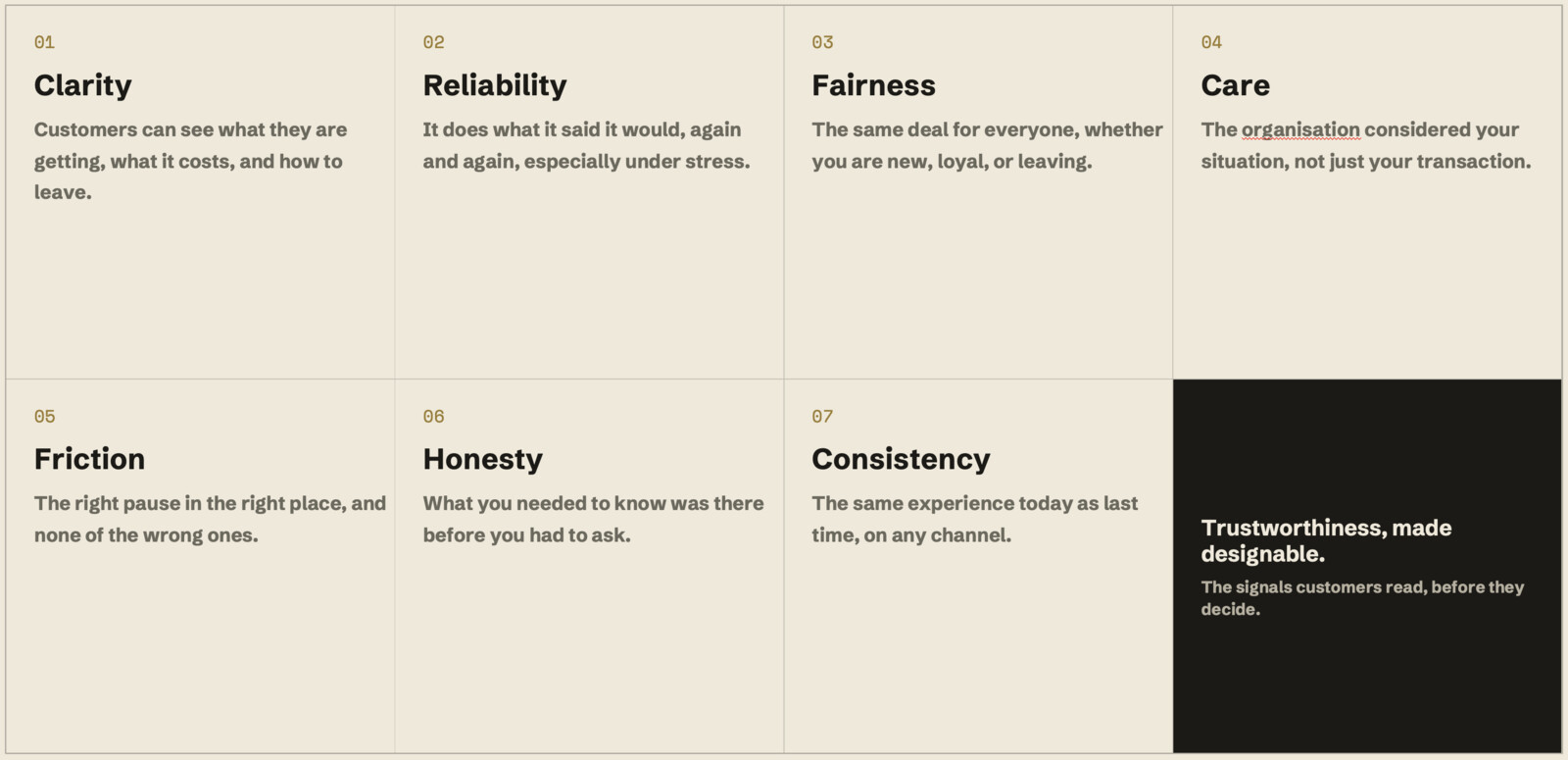
With Daljit Singh and Nicolas Roope, I co-founded Sideways, a behavioural design practice for regulated businesses, working across London and Melbourne. The model runs on two instruments. The Seven Trust Signals read how trustworthy an organisation appears from the outside, using only public evidence. The Trust Scoreboard goes deeper: a structured diagnostic that scores the four dimensions and turns the findings into a ranked list of design fixes, least effort and highest impact first.
We are building the Scoreboard with AI. The technology gathers and organises evidence at a scale a human team can't, and every score carries a citation: no evidence, no score. The scoring itself stays deterministic and human-validated, because a black-box trust score would be exactly the thing we advise clients against.
Sideways is live at trustsideways.com, with early client work under way in financial services. We held our first event in London, and the thinking is set out in my article Design for trustworthiness, not trust. Next is extending the model to AI itself: as responsible AI regulation follows the path Consumer Duty took, the same four dimensions apply to the systems firms are now deploying.
A behavioural design practice for regulated businesses, working across London and Melbourne.
My role: Co-founder, trust model and diagnostic design, AI architecture